
PhD position in Spatial Statistics
Umeå University, Faculty of Science and Technology
Umeå University is one of Sweden’s largest higher education institutions with over 41,500 students and about 4,600 employees. The University offers a diversity of high-quality education and world-leading research in several fields. Notably, the groundbreaking discovery of the CRISPR-Cas9 gene-editing tool, which was awarded the Nobel Prize in Chemistry, was made here. At Umeå University, everything is close. Our cohesive campuses make it easy to meet, work together and exchange knowledge, which promotes a dynamic and open culture.
The ongoing societal transformation and large green investments in northern Sweden create enormous opportunities and complex challenges. For Umeå University, conducting research about – and in the middle of – a society in transition is key. We also take pride in delivering education to enable regions to expand quickly and sustainably. In fact, the future is made here.
Are you interested in learning more? Read about Umeå university as a workplace
The Department of Mathematics and Mathematical Statistics conducts research in computational mathematics, discrete mathematics, mathematical modelling and analysis, and mathematical statistics. Our teaching is conducted at all levels and includes mathematics, mathematical statistics and computational science. Among our partners are international research groups, academic institutions, public organizations and companies.
The Department of Mathematics and Mathematical Statistics is opening a PhD position in spatial statistics. The position covers four years of doctoral studies, including participation in research and doctoral courses. The last day to apply is April 30th, 2026.
Project description and tasks
Spatial data arise in several forms, including areal data, geostatistical measurements of continuous fields, and point pattern data. In point pattern data, the primary information consists of the locations of events observed within a spatial region and, in many applications, over time. Examples include the positions of trees in a forest, disease cases in epidemiology, crime incidents in cities, traffic events on transportation networks, or animal observations in ecological studies. These data are commonly analysed using spatial or spatio-temporal point processes, which describe how events occur and interact. In many applications, each event also carries additional information, such as a type, size, or environmental measurement, leading to marked point patterns in which the event locations, times, and associated attributes are of interest.
The primary objective of this PhD project is to develop adaptive statistical models for marked spatial and spatio-temporal point processes. Many real-world systems exhibit substantial spatial heterogeneity and temporal variation and cannot be adequately described by models that assume a uniform structure. The project aims to develop flexible models that allow key characteristics of the process, such as event occurrence patterns, mark behaviour, and interactions between events, to vary locally in space and evolve over time. The research will include model development, statistical inference and diagnostic methods, and applications to real datasets where non-stationarity and evolving dynamics play an important role.
Qualifications
The doctoral student will be admitted to doctoral studies in Computational Mathematics and Statistics.
To be admitted for studies at the doctoral level, the applicant must hold a degree at the second-cycle level, have completed at least 240 ECTS credits, including at least 60 ECTS credits at the second-cycle level, or have otherwise acquired essentially equivalent knowledge within or outside Sweden. To fulfil the specific entry requirements to be admitted for studies at the doctoral level in computational mathematics and statistics, the applicant must have completed at least 90 ECTS credits within the subject of computational mathematics and statistics (including mathematical statistics, mathematics, computer science, and closely related fields), of which at least 30 ECTS credits shall have been acquired at the second-cycle level. The entry requirements specified above are also considered fulfilled by applicants who have acquired essentially equivalent knowledge through other means.
Good programming skills in R are required. Documented knowledge of spatial statistics, stochastic processes, and point process modelling is considered a merit.
Good command of English, both written and spoken, is required. The candidate is expected to take an active role in developing the doctoral project and to contribute to the research activities within the department. The candidate should be motivated, have a genuine interest in methodological research, and be able to work both independently and collaboratively. Good communication skills and a structured and solution-oriented approach to research are essential.
The assessment of applicants is based on their qualifications and ability to benefit from the doctoral education they will receive.
About the employment
The position is intended to result in a doctoral degree. The main task of doctoral students is to pursue their doctoral studies, including active participation in research and doctoral courses. The duties may include teaching or other departmental work, although duties of this kind may not comprise more than 20 percent of a full-time post. The employment is for a fixed term of four years full-time or up to five years when teaching part-time. Salary is set according to the salary ladder for PhD positions at Umeå University. Employment commences in the fall of 2026 or by agreement.
Application
Applications will be accepted via our recruitment system. The deadline for applications is April 30th, 2026. Log in and apply via the button at the bottom of the page. The application must include the following documents written in English or Swedish, in PDF or Word format:
- A cover letter briefly describing your qualifications and research interests, an explanation of why you are applying for the position and why you feel your qualifications and experience are relevant.
- Curriculum vitae.
- Authenticated copies of degree certificates, diplomas or equivalent, including documentation of completed academic courses, received grades, and other certificates.
- Copies of relevant work, such as a master’s thesis or articles you have authored or co-authored. If the master’s thesis has not been completed before the application deadline, a summary of the master’s thesis project and current progress shall be included. The summary can, at most, be five pages, including figures and references.
- Your GMAT (or GRE) and TOEFL/IELTS test scores, if available.
- Contact details for at least two references.
The Department of Mathematics and Mathematical Statistics values the qualities that gender balance brings to the department. We are therefore particularly keen to hear from female applicants.
Pursuant to Chapter 12 Section 2 of the Swedish Higher Education Ordinance (SFS 1993:100), the decision regarding the position cannot be appealed.
Life in Umeå
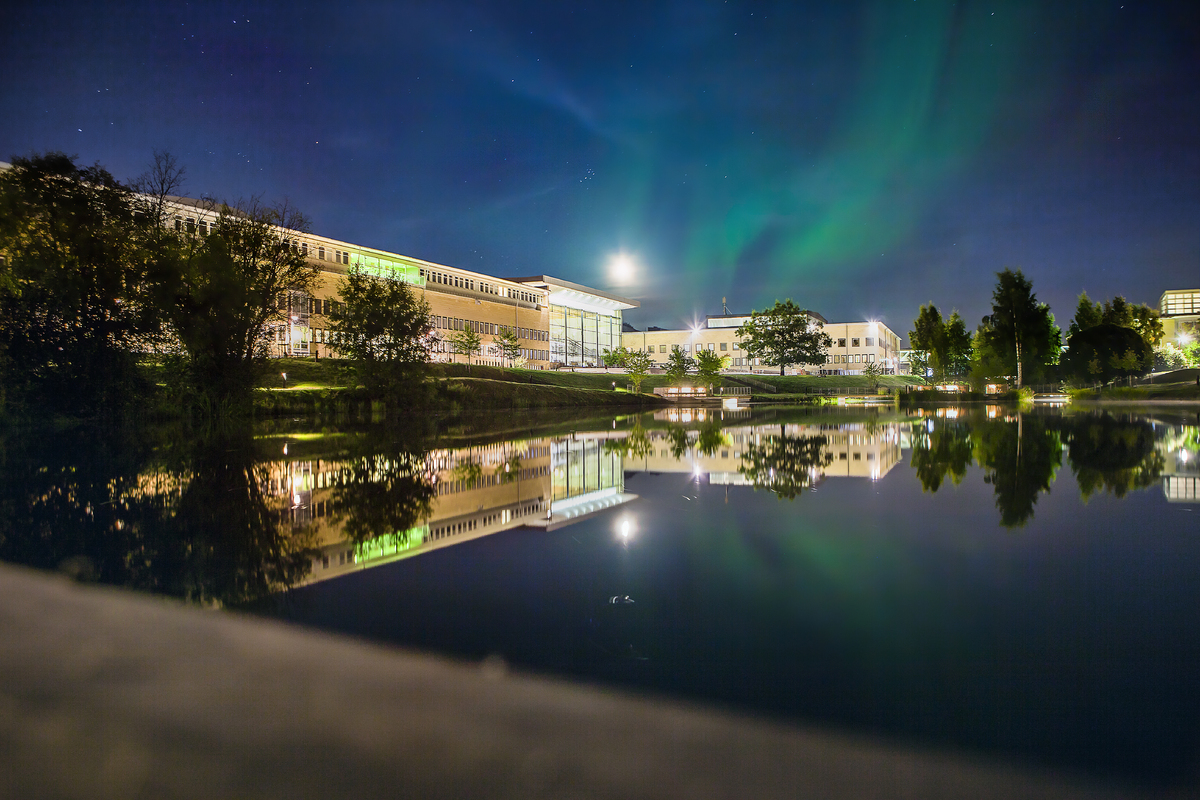
Umeå is a young, creative, and steadily growing city of about 135,000 people, where students make up a big part of everyday life. That mix gives the city an easy-going yet lively feel, with plenty of cafés, pubs, small venues, and cultural events, without the stress or pace of a big city. In 2014, Umeå was named a European Capital of Culture, a recognition that encouraged even more cultural activity, from festivals and concerts to institutions such as Norrlandsoperan and Bildmuseet. Day to day, though, Umeå is simply a comfortable place to live, safe, compact, and easy to get around, especially by bike. As the largest city in northern Sweden, it offers what you need while staying friendly, calm, and close to home. What people often appreciate most is how close you stay to nature here. Forest paths, the river, and lakes are all woven into the city, and in winter, the snow turns Umeå into a cosy, activity-filled place. Several Christmas markets appear around town, and ski tracks are only a 15-to-20-minute walk from the university. The seasons are clear and shape life in a gentle, familiar way: candle-lit December evenings, crisp spring days, and the long, bright light of early summer. It is the kind of place where you can finish work, step outside, and be in the woods or by the water almost immediately. Visitors often say it plainly: Umeå is a pretty cool place to live, and it is easy to feel that once you are here.
Additional information
Further information is provided by Mehdi Moradi (mehdi.moradi@umu.se).
Further information about the Department of Mathematics and Mathematical Statistics:
https://www.umu.se/en/department-of-mathematics-and-mathematical-statistics/
Welcome with your application!
| Type of employment | Temporary position |
|---|---|
| Employment expires | 2030-08-31 |
| Contract type | Full time |
| First day of employment | Fall 2026 or by agreement |
| Salary | Månadslön |
| Number of positions | 1 |
| Full-time equivalent | 100% |
| City | Umeå |
| County | Västerbottens län |
| Country | Sweden |
| Reference number | AN 2026/312 |
| Contact |
|
| Union representative |
|
| Published | 26.Feb.2026 |
| Last application date | 30.Apr.2026 |